
Characteristics of Conjunctival Melanocytic Tumor Patients in a Tertiary Hospital: A 4-Year Study

Article Sidebar
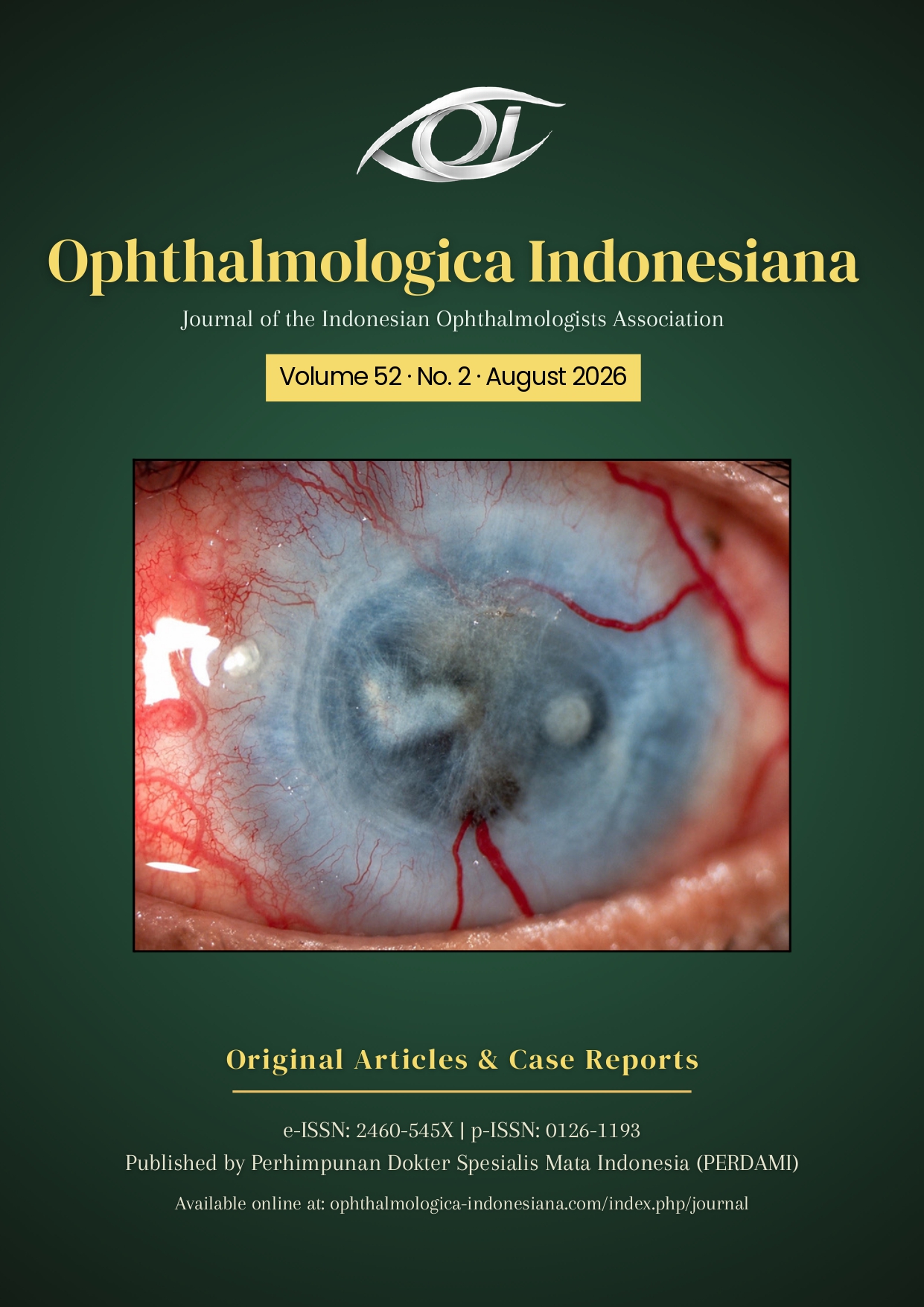
- conjunctival melanocytic tumor, melanoma maligna, compound nevi
Abstract
Introduction: Conjunctival neoplasms includes melanocytic and nonmelanocytic tumors, and most are benign. Due to their rarity in the general population, it is important to consider the demographic, clinical signs, symptoms, and histopathological features to make the correct diagnosis. This study aims to describe the demographic, clinical, and histopathology of Conjunctival Melanocytic Tumors patients in a Tertiary Hospital. Methods: A retrospective study held from the medical record of patients with diagnosis conjunctival melanocytic tumor from January 2019 - September 2023 in a Tertiary Hospital. Age, sex, laterality, clinical signs, symptoms, procedure, and histopathology result were recorded. Results: Thirteen patients were identified (n=13). The distribution was nearly equal between genders (54% male, 46% female), with a mean age of 39 years (range: 4–69 years). All cases were unilateral. The most frequent clinical presentation was a painless lump (69%), primarily localized in the temporal region (77%). Surgical interventions included simple excision (69.2%) and wide excision (30.8%). Histopathological analysis revealed that 61.5% of lesions were malignant melanoma, while 38.5% were compound nevi. Conclusion: In this study, it was found that conjunctival melanocytic tumor was found equal in both genders, majority in adult age, mostly presenting with painless lumps on the temporal region of bulbar conjunctiva. Most patient in this study were diagnosed with melanoma maligna, because usually patient with nevi were not referred to tertiary hospital. Majority of the patient underwent excision while the others underwent wide excision.
Full text article
References
1. Whittington CP, Bresler SC, Simon C, Shields CL, Patel RM. Melanocytic lesions of the conjunctiva: An up-to-date review. Diagnostic Histopathology. 2023.
2. Misotten GS, Keijser S, De Keizer JW, De Wolff-Rouendaal D. Con- junctival melanoma in the Netherlands: a nationwide study. Invest Oph- thalmol Vis Sci. 2005;46:75–82.
3. Norregaard JC, Gerner N, Jensen OA, Prause JU. Melanoma maligna of the conjunctiva: occurrence and survival following surgery and ra- diotherapy in a Danish population. Graefes Arch Clin Exp Ophthalmol. 1996;234:569–572.
4. Tuomaala S, Eskelin S, Tarkkanen A, Kivela T. Population-based assessment of clinical characteristics predicting outcome of conjunctival melanoma in whites. Invest Ophthalmol Vis Sci. 2002;43:3399– 3408.
5. Virgili G, Parravano M, Gatta G, et al. Incidence and survival of patients with conjunctival melanoma in Europe. JAMA Ophthalmol. 2020;138:601–608.
6. Alkatan HM, Alshomar KM, Helmi HA, Alhothali WM, Alshalan AM. Conjunctival Lesions: A 5-Year Basic Demographic Data and Clinicopathological Review in a Tertiary Eye Care Hospital. J Epidemiol Glob Health. 2022 Mar;12(1):25-39.
7. Shields CL, Fasiuddin AF, Mashayekhi A, et al. Conjunctival nevi: clinical features and natural course in 410 consecutive patients. Arch Ophthalmol 2004 Feb; 122: 167e75. https://doi.org/10. 1001/archopht.122.2.167. Erratum in: Arch Ophthalmol. 2006 Feb;124(2):198.
8. Luong, H.N. and Ramasubramanian, A. (2023) 'Conjunctival tumors in children', Advances in Ophthalmology and Optometry, 8(1), pp. 59-73. doi:10.1016/j.yaoo.2023.02.006.
9. Grimes JM, Shah NV, Samie FH, et al. Conjunctival melanoma: current treatments and future options. Am J Clin Dermatol 2020 Jun; 21: 371e81.
10. Alkatan HM, Al-Arfaj KM, Maktabi A. Conjunctival nevi: Clinical and histopathologic features in a Saudi population. Ann Saudi Med. 2010 Jul-Aug;30(4):306-12. doi: 10.4103/0256-4947.65265. PMID: 20622349; PMCID: PMC2931783.
Authors
Copyright (c) 2026 Fadhila Khairunnisa Poerwoko, Raja Erinda, Faiza Rizky A.S

This work is licensed under a Creative Commons Attribution-NonCommercial-ShareAlike 4.0 International License.